СК-11

СК-11 platform
- CK-11 is an innovative platform with a configurable SCADA/EMS/ADMS/DTS application suite
for building automated systems for the operational and technological management of power facilities. - The application suite can be configured to meet the current needs of the enterprise and easily adapted as new requirements emerge.
- A core principle of the CK-11 platform is its openness to integrating applications from different vendors based on international standards.
To ensure efficient operation within a hierarchy of distributed control centers, CK-11 offers two main approaches:
— a distributed control system with local nodes and a shared information space across all control centers
— a distributed control system with local nodes and a shared information space across all control centers
A centralized system offers advantages in terms of simplicity, ease of maintenance, and reduced hardware costs, however, it also has certain limitations, including the presence of critical nodes and increased requirements for the continuous availability of extended communications infrastructure providing access to the system core. In recent years, the declining cost and increasing reliability of telecommunication services have made this model increasingly popular.
A distributed control system based on CK-11 provides maximum autonomy and resilience for each system node within a local control center, maintains a synchronized state of the information model across all nodes, and enables real-time data and event exchange.
The choice of technology for building a unified automated system across a hierarchy of control centers depends on the enterprise's operational and technological management policy, operating conditions, and IT landscape.
Both approaches support the creation of disaster-resilient systems through control center redundancy, enabling a complete transfer of operational and technological management functions to a backup control center. Disaster resilience relies on replicating the information model and data flows between the primary and backup server groups and control centers. To create a shared information space, CK-11 provides an inter-level information exchange mechanism known as the InfoLift. It operates across all control centers and managed facilities within the shared information space and automatically delivers data to all relevant users whenever changes occur or new information becomes available.
The CK-11 platform includes tools for managing a common information model of the power grid, tools for creating a unified information system across a hierarchy of control centers, infrastructure for running server and client applications in different operating modes, including redundancy and orchestration capabilities, an information storage subsystem, self-diagnostics tools, a vector graphics subsystem, a reporting subsystem, integration tools, and other components.
Core standards and technologies behind CK-11 architecture:
— IEC 61970, 61968 (CIM)
— GOST 58651
— W3C standards and technologies: XML, XSLT, SOAP, WSDL, XAML, RDF
— OPC Unified Architecture (IEC 62541)
— TCP/IP suite of industry standards for communications over LAN and WAN networks
— IEC 61850
— IEC 60870-6 TASE.2 (ICCP)
— IEC 61870-5-101/104
— Service-Oriented Architecture (SOA)
— .NET Core
СК-11 Application Suite
The application suite is tailored to the enterprise's needs and can be modified throughout the system lifecycle
An enterprise-grade engine for high-performance processing, monitoring, and storage of real-time data streams—whether automated, manually entered, or generated by third-party applications. It serves as the mission-critical hub for Network Control Center dispatchers
- Engineered for big data and high-velocity streams from diverse sources. The system ensures long-term data retention with smart reduction algorithms, while mission-critical data is preserved in an immutable format.
- The advanced Topology Processor provides intuitive visualization of conducting equipment with dynamic coloring for deep network analysis. Intelligent manual input streamlines operations by automating routine tasks and implementing rigorous dispatcher action control.
- Analysis data is sourced from a diverse ecosystem, including telemetry, Automated meter reading and control system, and meteorological feeds. To ensure absolute data integrity, the system can restore invalid telemetry via redundant sources, reporting/planned parameters, forecasts, or manual input. Every incoming value undergoes a comprehensive validity verification process.
- The platform tracks advanced statistical telemetry behavior—including extrema, limit violations, and parameter surges. This intelligence is critical for precision equipment tuning and proactive outage rate reduction.
- An intelligent notification engine keeps users informed of critical system events. Events are organized into smart summaries, tailored by event type and associated objects.
- CK-11 empowers users with a sophisticated analytical suite for complex calculations. The base calculation subsystem features an intuitive logic editor, supporting universal aggregation (integrals, weighted/arithmetic means, extrema, sums) across customizable timeframes from 1 minute to 1 year.
- The Analytical Calculation subsystem provides advanced operational intelligence for complex scenarios involving extensive information model data. It enables retrospective analysis for predictive modeling and the automation of complex technological process chains.
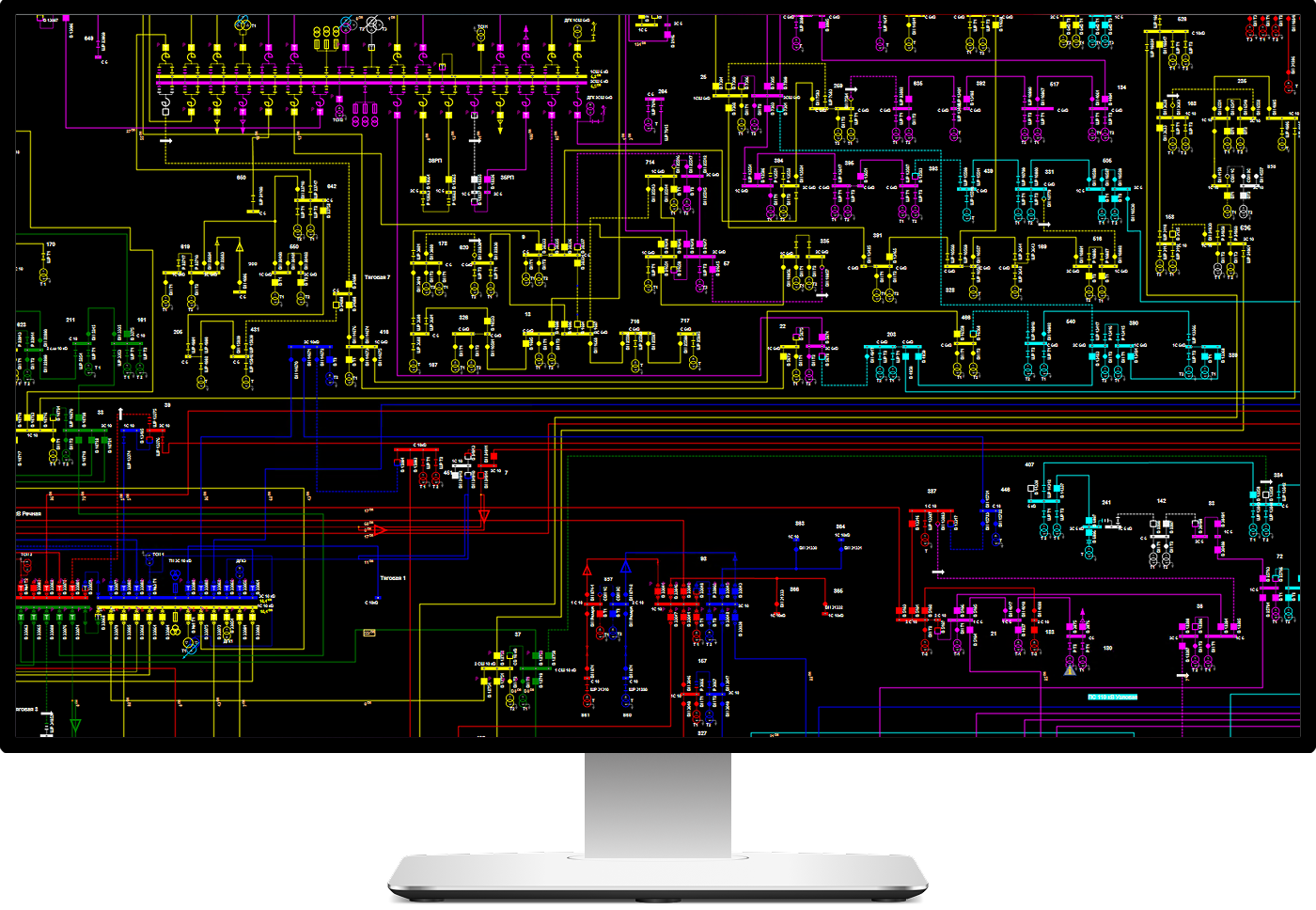
- A core differentiator of CK-11 is its high-fidelity visualization of the network topology and operating state, featuring advanced display control tools. Dynamic scaling enables a layered presentation of data, with the level of detail automatically adapting to the current zoom level. Simultaneously, the Topology Processor manages dynamic coloring, allowing for comprehensive network analysis in various modes:
- by energization status;
- by operational responsibility;
- by supply centers;
- by voltage class (independent of current network topology);
- by asset ownership.
- The Topology Tracing service enables deep-dive network analysis by highlighting critical electrical paths:
- path from a selected element to the supply center;
- path between two selected network elements;
- all elements powered by the same supply center as the selected one;
- branch powered via selected switch or line.
- CK-11 integrates comprehensive management of temporary equipment. Dispatchers can digitally map temporary grounds, jumpers, cuts, unbolting, and mobile generators, alongside dispatcher and safety tags. This temporary equipment is dynamically factored into both topological coloring and real-time SCADA/ADMS operations. The system maintains an inventory log of installed temporary equipment; for temporary grounds and mobile generators, it tracks deployment from warehouse stocks, recording equipment numbers and verification dates. Dispatcher tags ensure personnel safety during equipment operation.
- The SCADA environment features full geospatial integration. The toolkit ranges from visualizing technological and infrastructure data on any map to loading fire reports and integrating cadastral maps, and from visualizing trouble tickets and outages to real-time tracking of field crews.
An enterprise-grade engine for high-performance processing, monitoring, and storage of real-time data streams—whether automated, manually entered, or generated by third-party applications. It serves as the mission-critical hub for Network Control Center dispatchers Engineered for big data and high-velocity streams from diverse sources. The system ensures long-term data retention with smart reduction algorithms, while mission-critical data is preserved in an immutable format.
- Топологический процессор обеспечивает визуальное отображение текущего состояния токопроводящего оборудования и позволяет анализировать схемы в различных режимах динамической раскраски. Интеллектуальный ручной ввод делает работу со схемами удобнее за счет автоматизации функций и контроля действий диспетчера.
- The advanced Topology Processor provides intuitive visualization of conducting equipment with dynamic coloring for deep network analysis. Intelligent manual input streamlines operations by automating routine tasks and implementing rigorous dispatcher action control.
Analysis data is sourced from a diverse ecosystem, including telemetry, Automated meter reading and control system, and meteorological feeds. To ensure absolute data integrity, the system can restore invalid telemetry via redundant sources, reporting/planned parameters, forecasts, or manual input. Every incoming value undergoes a comprehensive validity verification process.
The platform tracks advanced statistical telemetry behavior—including extrema, limit violations, and parameter surges. This intelligence is critical for precision equipment tuning and proactive outage rate reduction.
An intelligent notification engine keeps users informed of critical system events. Events are organized into smart summaries, tailored by event type and associated objects.
CK-11 empowers users with a sophisticated analytical suite for complex calculations. The base calculation subsystem features an intuitive logic editor, supporting universal aggregation (integrals, weighted/arithmetic means, extrema, sums) across customizable timeframes from 1 minute to 1 year.
The Analytical Calculation subsystem provides advanced operational intelligence for complex scenarios involving extensive information model data. It enables retrospective analysis for predictive modeling and the automation of complex technological process chains.
A core differentiator of CK-11 is its high-fidelity visualization of the network topology and operating state, featuring advanced display control tools. Dynamic scaling enables a layered presentation of data, with the level of detail automatically adapting to the current zoom level. Simultaneously, the Topology Processor manages dynamic coloring, allowing for comprehensive network analysis in various modes:
- by energization status;
- by operational responsibility;
- by supply centers;
- by voltage class (independent of current network topology);
- by asset ownership.
The Topology Tracing service enables deep-dive network analysis by highlighting critical electrical paths:
- path from a selected element to the supply center;
- path between two selected network elements;
- all elements powered by the same supply center as the selected one;
- branch powered via selected switch or line.
CK-11 integrates comprehensive management of temporary equipment. Dispatchers can digitally map temporary grounds, jumpers, cuts, unbolting, and mobile generators, alongside dispatcher and safety tags. This temporary equipment is dynamically factored into both topological coloring and real-time SCADA/ADMS operations. The system maintains an inventory log of installed temporary equipment; for temporary grounds and mobile generators, it tracks deployment from warehouse stocks, recording equipment numbers and verification dates. Dispatcher tags ensure personnel safety during equipment operation.
The SCADA environment features full geospatial integration. The toolkit ranges from visualizing technological and infrastructure data on any map to loading fire reports and integrating cadastral maps, and from visualizing trouble tickets and outages to real-time tracking of field crews.
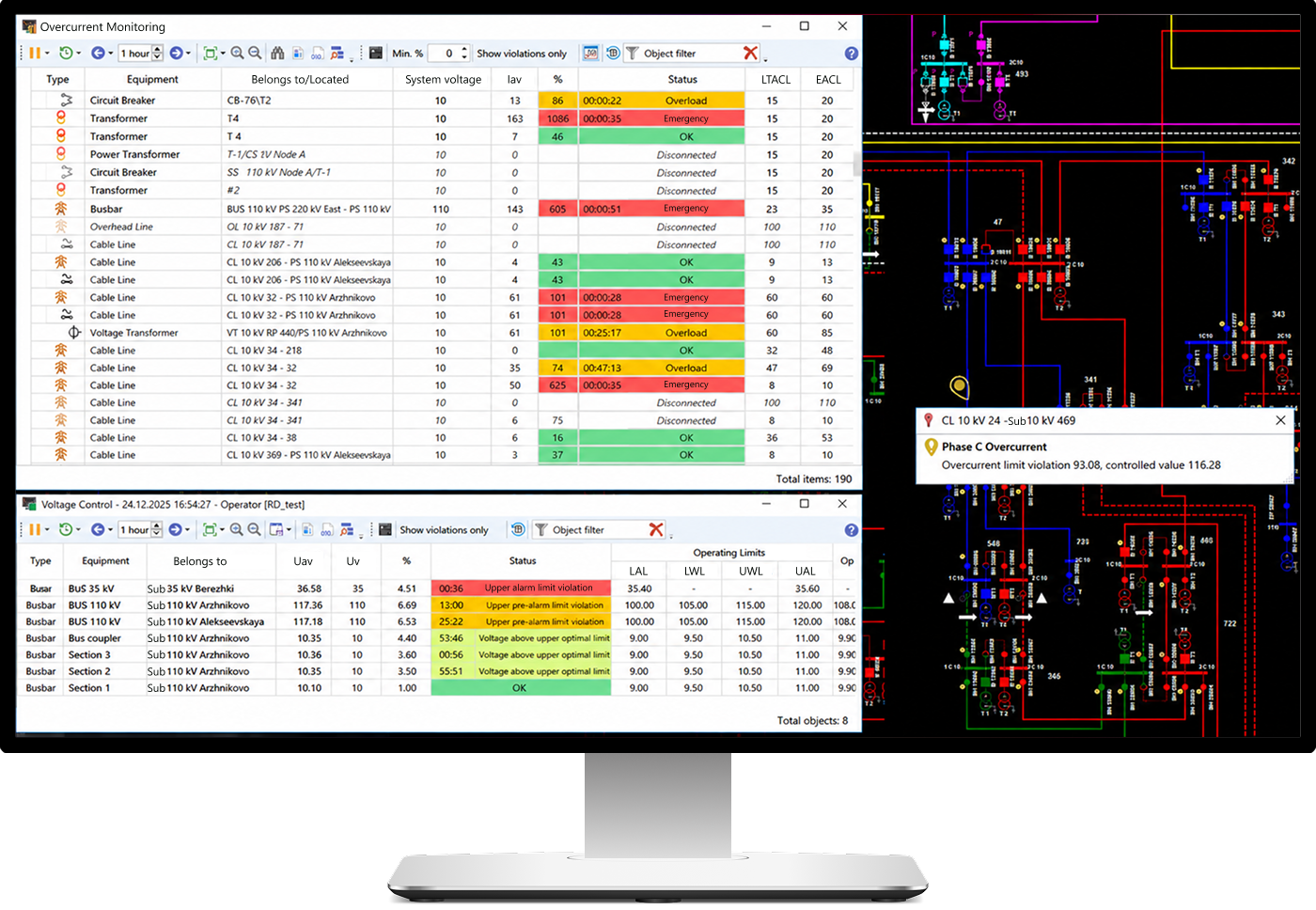
The system dynamically calculates current operational limits for current and voltage, identifying equipment equipment limit violations considering real-time weather conditions to enable rapid response. It also monitors permissible durations for equipment in steady-state modes
- Upon detection of a violation on monitored equipment, the system triggers immediate visual alerts on the diagram, provides detailed diagnostics via specialized control forms, modifies telemetry quality flags, and aggregates violation statistics for automated reporting.
- Monitoring operates as a continuous background process; the dispatcher's attention is engaged only when immediate action is required within their specific area of responsibility (AoR).
- Dedicated subsystems provide precision monitoring. The Voltage Level Monitoring subsystem tracks operational limit violations and optimal voltage schedules to guarantee power supply quality.
- The Current Load Monitoring subsystem detects equipment overloads by correlating current with ambient temperature and duration, while also monitoring phase current asymmetry.
The system dynamically calculates current operational limits for current and voltage, identifying equipment equipment limit violations considering real-time weather conditions to enable rapid response. It also monitors permissible durations for equipment in steady-state modes. Upon detection of a violation on monitored equipment, the system triggers immediate visual alerts on the diagram, provides detailed diagnostics via specialized control forms, modifies telemetry quality flags, and aggregates violation statistics for automated reporting.
- Monitoring operates as a continuous background process; the dispatcher's attention is engaged only when immediate action is required within their specific area of responsibility (AoR).
- Monitoring operates as a continuous background process; the dispatcher's attention is engaged only when immediate action is required within their specific area of responsibility (AoR).
Dedicated subsystems provide precision monitoring. The Voltage Level Monitoring subsystem tracks operational limit violations and optimal voltage schedules to guarantee power supply quality.
The Current Load Monitoring subsystem detects equipment overloads by correlating current with ambient temperature and duration, while also monitoring phase current asymmetry.
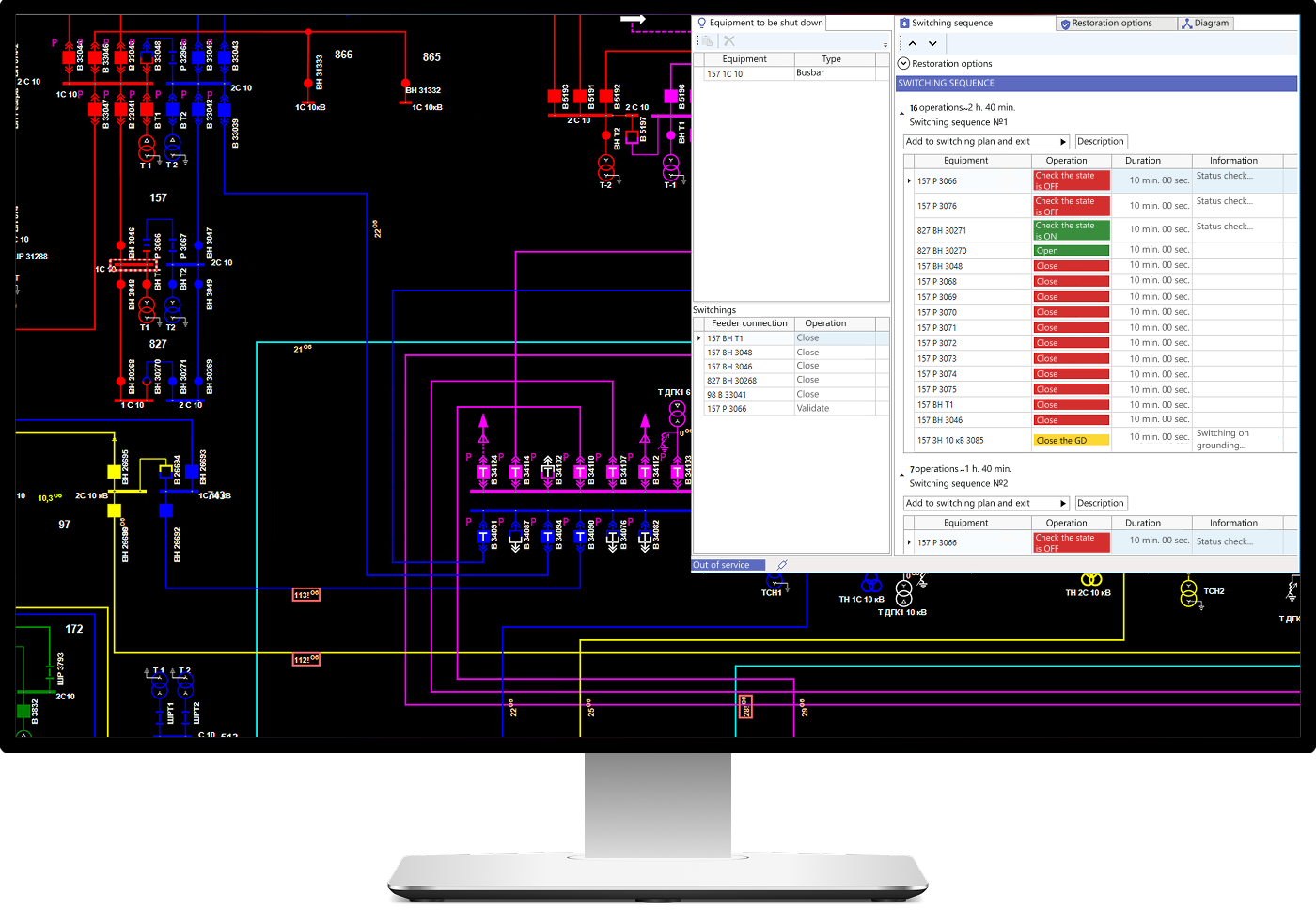
Automates switching operations in high-voltage and distribution networks via intelligent switching programs/orders, dynamically generated based on the current topology and objective (e.g., maintenance outage or normal topology restoration, etc.)
- Depending on network observability, scheduled and emergency outages can be fully automated (with dispatcher oversight) or managed via direct commands to field crews and on-duty personnel, featuring automatic diagram activation to reflect the actual state, even in non-telemechanized sectors.
- All switching steps are captured in the Electronic Logbook with multi-level verification for every operation to ensure zero-error execution.
- The system provides real-time visibility into capacity reserves connected to the remedial action scheme and load shedding volumes based on emergency schedules and telemetry. It supports group telecontrol for efficient load shedding and features advanced safety interlocks (e.g., administrative interlock, energized ground protection, and short-circuit prevention).
- The integrated FLISR assistant suggests optimal switching sequences for maintenance or emergency recovery based on real-time network topology and operational limits, eliminating planning errors and accelerating decision-making.
- Even greater efficiency is achieved through AutoFLISR, a service for the automated restoration of customer power supply. It automatically identifies the faulted section, isolates the damaged equipment or power line, and restores power to customers using the optimal calculated path—requiring zero human intervention.
Automates switching operations in high-voltage and distribution networks via intelligent switching programs/orders, dynamically generated based on the current topology and objective (e.g., maintenance outage or normal topology restoration, etc.) Depending on network observability, scheduled and emergency outages can be fully automated (with dispatcher oversight) or managed via direct commands to field crews and on-duty personnel, featuring automatic diagram activation to reflect the actual state, even in non-telemechanized sectors.
- All switching steps are captured in the Electronic Logbook with multi-level verification for every operation to ensure zero-error execution
- All switching steps are captured in the Electronic Logbook with multi-level verification for every operation to ensure zero-error execution.
The system provides real-time visibility into capacity reserves connected to the remedial action scheme and load shedding volumes based on emergency schedules and telemetry. It supports group telecontrol for efficient load shedding and features advanced safety interlocks (e.g., administrative interlock, energized ground protection, and short-circuit prevention).
The integrated FLISR assistant suggests optimal switching sequences for maintenance or emergency recovery based on real-time network topology and operational limits, eliminating planning errors and accelerating decision-making.
Even greater efficiency is achieved through AutoFLISR, a service for the automated restoration of customer power supply. It automatically identifies the faulted section, isolates the damaged equipment or power line, and restores power to customers using the optimal calculated path—requiring zero human intervention.
A comprehensive suite of network analysis tools, including unbalanced load flow analysis in current topology, allowing for "what-if" scenario testing, short-term operational planning, and strategic network development
- Operational analytics run in real-time, providing dispatchers with advisory alerts and signal indicators on graphical diagrams. A dedicated "Study Mode" allows dispatchers to simulate and evaluate the impact of potential switching operations.
- For non-operational strategic tasks, the system offers advanced interactive analysis, including any-mode simulation, load forecasting, and equipment failure contingency analysis. To address complex challenges beyond real-time operational control of electrical networks, the platform offers advanced interactive analysis. This empowers users to simulate any state of operating conditions, perform load forecasting, and conduct equipment failure contingency analysis, among other sophisticated calculations.
- The system intelligently streamlines the model to the optimal size for specific tasks, creating agile analytical models. Transformation algorithms are managed centrally and kept active.
- State estimation leverages advanced data on conducting equipment and proprietary observability restoration algorithms.
The system provides:
- gross error correction for switch state signaling and telemetry;
- transformer tap changer position estimation;
- capacity estimation for сontrolled shunt reactors, static var compensators, and STATCOM;
- explicit switch and measurement accounting.
- Real-time state estimation allows dispatchers to visualize calculated parameters on non-telemechanized network sections and replace invalid measurements with high-accuracy estimated values.
- An extensive toolkit is provided for the calculation and analysis of normal, emergency, and post-emergency power flows. It is possible to create a group of independent information models for specific areas, network topologies, or analysis tasks based on the full information model of the physical equipment.
- CK-11 enables precision energy balancing and technical/commercial loss analysis in distribution networks. By integrating meter data and topology changes, it localizes high-loss areas and detects unauthorized power draws or metering anomalies.
- Unbalanced load flow analysis allows for the calculation of single-, double-, and three-phase short-circuit currents to verify switch breaking capacity and thermal/electrodynamic withstand of equipment, locate power line faults, and optimize relay protection setpoints.
- Data on switch breaking capacity and values characterizing the electrodynamic and thermal withstand of equipment are used to monitor the breaking capacity and equipment withstand against calculated short-circuit currents. This control can be carried out in real-time as the electrical network's operating state changes.
comprehensive suite of network analysis tools, including unbalanced load flow analysis in current topology, allowing for "what-if" scenario testing, short-term operational planning, and strategic network development. Operational analytics run in real-time, providing dispatchers with advisory alerts and signal indicators on graphical diagrams. A dedicated "Study Mode" allows dispatchers to simulate and evaluate the impact of potential switching operations.
- For non-operational strategic tasks, the system offers advanced interactive analysis, including any-mode simulation, load forecasting, and equipment failure contingency analysis. To address complex challenges beyond real-time operational control of electrical networks, the platform offers advanced interactive analysis. This empowers users to simulate any state of operating conditions, perform load forecasting, and conduct equipment failure contingency analysis, among other sophisticated calculations.
- For non-operational strategic tasks, the system offers advanced interactive analysis, including any-mode simulation, load forecasting, and equipment failure contingency analysis. To address complex challenges beyond real-time operational control of electrical networks, the platform offers advanced interactive analysis. This empowers users to simulate any state of operating conditions, perform load forecasting, and conduct equipment failure contingency analysis, among other sophisticated calculations.
The system intelligently streamlines the model to the optimal size for specific tasks, creating agile analytical models. Transformation algorithms are managed centrally and kept active.
State estimation leverages advanced data on conducting equipment and proprietary observability restoration algorithms.
The system provides:
- gross error correction for switch state signaling and telemetry;
- transformer tap changer position estimation;
- capacity estimation for сontrolled shunt reactors, static var compensators, and STATCOM;
- explicit switch and measurement accounting.
Real-time state estimation allows dispatchers to visualize calculated parameters on non-telemechanized network sections and replace invalid measurements with high-accuracy estimated values.
An extensive toolkit is provided for the calculation and analysis of normal, emergency, and post-emergency power flows. It is possible to create a group of independent information models for specific areas, network topologies, or analysis tasks based on the full information model of the physical equipment.
CK-11 enables precision energy balancing and technical/commercial loss analysis in distribution networks. By integrating meter data and topology changes, it localizes high-loss areas and detects unauthorized power draws or metering anomalies.
Unbalanced load flow analysis allows for the calculation of single-, double-, and three-phase short-circuit currents to verify switch breaking capacity and thermal/electrodynamic withstand of equipment, locate power line faults, and optimize relay protection setpoints.
Data on switch breaking capacity and values characterizing the electrodynamic and thermal withstand of equipment are used to monitor the breaking capacity and equipment withstand against calculated short-circuit currents. This control can be carried out in real-time as the electrical network's operating state changes.
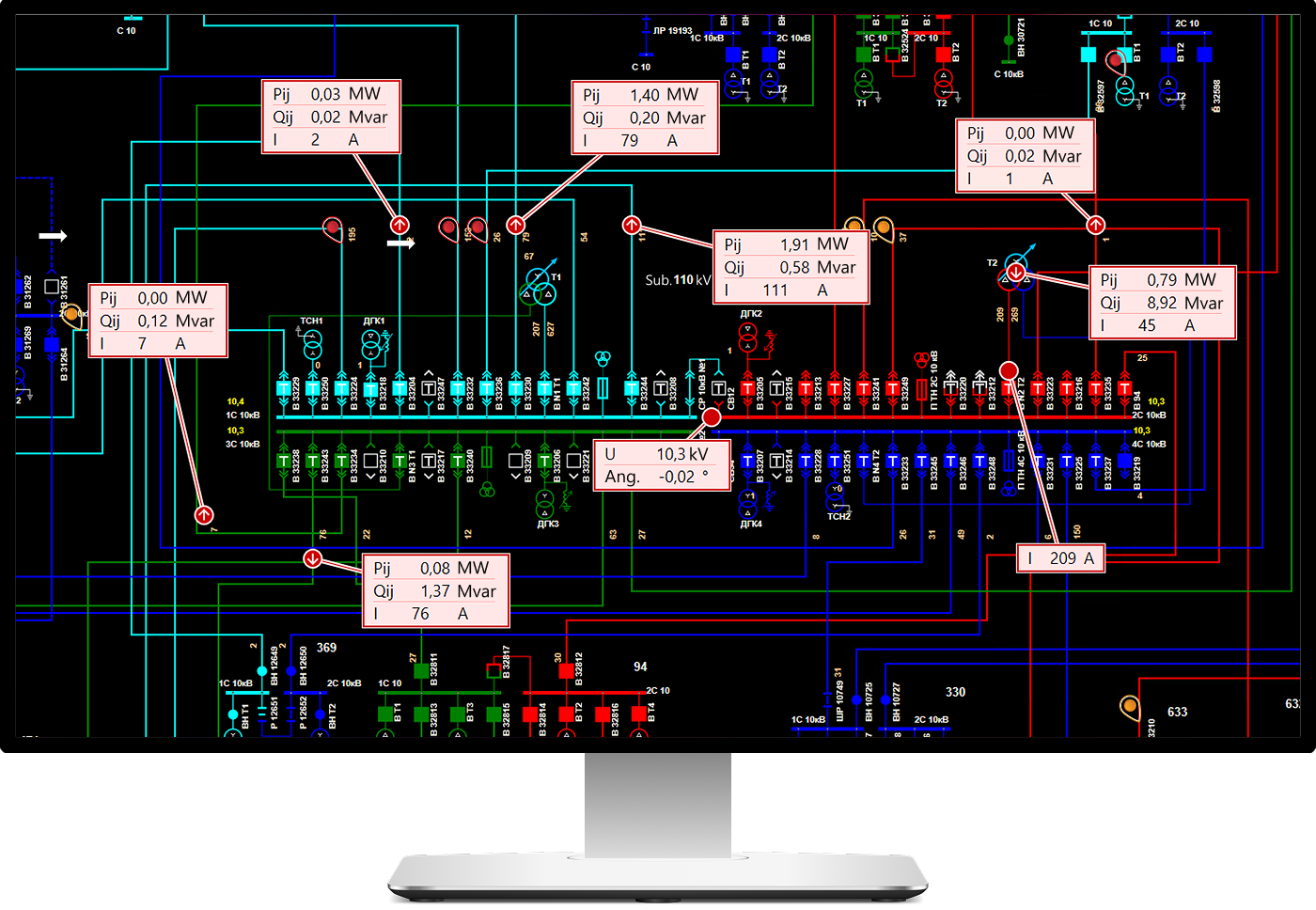
CK-11 features a fully isolated simulation environment, completely separated from the primary control mode, that emulates the dispatching ecosystem with high-fidelity reproduction of all critical real-world power system processes
- Trainees use the exact toolset as in live operations, progressing from basic induction to mastery of typical, pre-emergency, and emergency network modes.
- Scenarios include dynamic network reconfiguration, load/generation shifts, and simulations of PPE use, operational communications, and temporary outage schedules. A specialized simulator is dedicated to mastering operational switching.
- The portfolio features three specialized simulators for operational and dispatching excellence.
Filin Simulator
A high-fidelity DTS simulator for power system control centers, designed to cultivate advanced management skills through dispatcher, system-wide, and inter-system emergency trainings and professional competitions. It can be used for dispatch, system-wide, and inter-system emergency response drills, professional skills competitions, and training in operating СK-11 components.
Filin is powered by a dynamic calculation model that reproduces power system behavior, calculating both power flow sequences between switching operations, disturbances and complex transient responses.
Key Capabilities:- Detailed modeling of:
- — transformers, taking into account the possibility of both longitudinal and transverse transformation ratio regulation;
- — emergency signaling;
- — remedial action scheme (RAS) devices (ULS, UIS, UVP, OCPD, PSP, etc.);
- — operational automation (ALFC, GAPC, Group Regulator of Reactive Power and Voltage, etc.);
- — frequency/voltage-dependent customer loads;
- — voltage regulators (SCB, CSR, SVC, STATCOM).
- Initial state generation (including SCADA archive integration)
- Scenario-based training with dynamic inputs:
- — emergency outages of switches, busbars, lines, and generating units;
- — operational and emergency automation failures;
- — communication channel/telemechanics breakdowns.
- Telecontrol simulation
- Participation of multiple control centres in a collaborative training
- Felix Simulator
A DTS simulator dedicated to network operational personnel, providing hands-on expertise in the operational and technological management of electrical grids. It enables personnel to gain skills in operational and technological management of electric power networks.
The Felix Simulator enables dispatch, substation/zone, district, and system-wide emergency response drills, as well as professional skills competitions for operations personnel. Precise network behavior is achieved through iterative power flow calculations and detailed modeling.
Key Capabilities:- Extensive parameter modeling:
- — primary equipment;
- — emergency signaling;
- — voltage-dependent customer loads;
- — voltage regulators (SCB, CSR, SVC, STATCOM);
- — network automation devices (ALT , UFLS , etc.);
- — temporary equipment (mobile generators, temporary grounds , jumpers/cuts on lines).
- Initial state generation (including SCADA archive integration)
- Scenario-based training with dynamic inputs:
- — emergency outages of switches, busbars, lines, and transformers;
- — grid automation failures;
- — communication channel/telemechanics breakdowns;
- — customer power loss reports.
- Simulation of telecontrol of switches and remote entry of temporary outage schedules
- Participation of multiple control centers in a single training session
- NOTS Simulator
The NOTS Simulator is designed to train personnel of electric grid operational dispatch control centers in the sequence of performing switching operations, as well as to conduct professional skills competitions.
Unlike DTS simulators, NOTS focuses exclusively on strict algorithmic adherence. Using a predefined reference action map, it provides formalized evaluation of every step. It can operate autonomously or as a verification module integrated with Filin/Felix.
Key Capabilities:- Specification of equipment faults in the training scenario
- Definition of additional events (emergency equipment outages, supplementary inputs, etc.) and their automatic triggering during training
- Training in both educational (with hints) and control mode
- Simulation of operational communications
- Simulation of working with personal protective equipment (PPE)
- Multi-user sessions
- Integrated switching and DTS training (with Filin/Felix)
- Reference action map generation (including automatic import from CK-11 switching programs)
- Automated performance evaluation and action logging
CK-11 features a fully isolated simulation environment, completely separated from the primary control mode, that emulates the dispatching ecosystem with high-fidelity reproduction of all critical real-world power system processes. Trainees use the exact toolset as in live operations, progressing from basic induction to mastery of typical, pre-emergency, and emergency network modes.
- Scenarios include dynamic network reconfiguration, load/generation shifts, and simulations of PPE use, operational communications, and temporary outage schedules. A specialized simulator is dedicated to mastering operational switching/
- Scenarios include dynamic network reconfiguration, load/generation shifts, and simulations of PPE use, operational communications, and temporary outage schedules. A specialized simulator is dedicated to mastering operational switching.
The portfolio features three specialized simulators for operational and dispatching excellence.
Filin Simulator A high-fidelity DTS simulator for power system control centers, designed to cultivate advanced management skills through dispatcher, system-wide, and inter-system emergency trainings and professional competitions. It can be used for dispatch, system-wide, and inter-system emergency response drills, professional skills competitions, and training in operating СK-11 components.
Filin is powered by a dynamic calculation model that reproduces power system behavior, calculating both power flow sequences between switching operations, disturbances and complex transient responses.
Key Capabilities:- Detailed modeling of:
- — transformers, taking into account the possibility of both longitudinal and transverse transformation ratio regulation;
- — emergency signaling;
- — remedial action scheme (RAS) devices (ULS, UIS, UVP, OCPD, PSP, etc.);
- — operational automation (ALFC, GAPC, Group Regulator of Reactive Power and Voltage, etc.);
- — frequency/voltage-dependent customer loads;
- — voltage regulators (SCB, CSR, SVC, STATCOM).
- Initial state generation (including SCADA archive integration)
- Scenario-based training with dynamic inputs:
- — emergency outages of switches, busbars, lines, and generating units;
- — operational and emergency automation failures;
- — communication channel/telemechanics breakdowns.
- Telecontrol simulation
- Participation of multiple control centres in a collaborative training
Felix Simulator A DTS simulator dedicated to network operational personnel, providing hands-on expertise in the operational and technological management of electrical grids. It enables personnel to gain skills in operational and technological management of electric power networks.
The Felix Simulator enables dispatch, substation/zone, district, and system-wide emergency response drills, as well as professional skills competitions for operations personnel. Precise network behavior is achieved through iterative power flow calculations and detailed modeling.
Key Capabilities:- Extensive parameter modeling:
- — primary equipment;
- — emergency signaling;
- — voltage-dependent customer loads;
- — voltage regulators (SCB, CSR, SVC, STATCOM);
- — network automation devices (ALT , UFLS , etc.);
- — temporary equipment (mobile generators, temporary grounds , jumpers/cuts on lines).
- Initial state generation (including SCADA archive integration)
- Scenario-based training with dynamic inputs:
- — emergency outages of switches, busbars, lines, and transformers;
- — grid automation failures;
- — communication channel/telemechanics breakdowns;
- — customer power loss reports.
- Simulation of telecontrol of switches and remote entry of temporary outage schedules
- Participation of multiple control centers in a single training session
NOTS Simulator The NOTS Simulator is designed to train personnel of electric grid operational dispatch control centers in the sequence of performing switching operations, as well as to conduct professional skills competitions.
Unlike DTS simulators, NOTS focuses exclusively on strict algorithmic adherence. Using a predefined reference action map, it provides formalized evaluation of every step. It can operate autonomously or as a verification module integrated with Filin/Felix.
Key Capabilities:- Specification of equipment faults in the training scenario
- Definition of additional events (emergency equipment outages, supplementary inputs, etc.) and their automatic triggering during training
- Training in both educational (with hints) and control mode
- Simulation of operational communications
- Simulation of working with personal protective equipment (PPE)
- Multi-user sessions
- Integrated switching and DTS training (with Filin/Felix)
- Reference action map generation (including automatic import from CK-11 switching programs)
- Automated performance evaluation and action logging
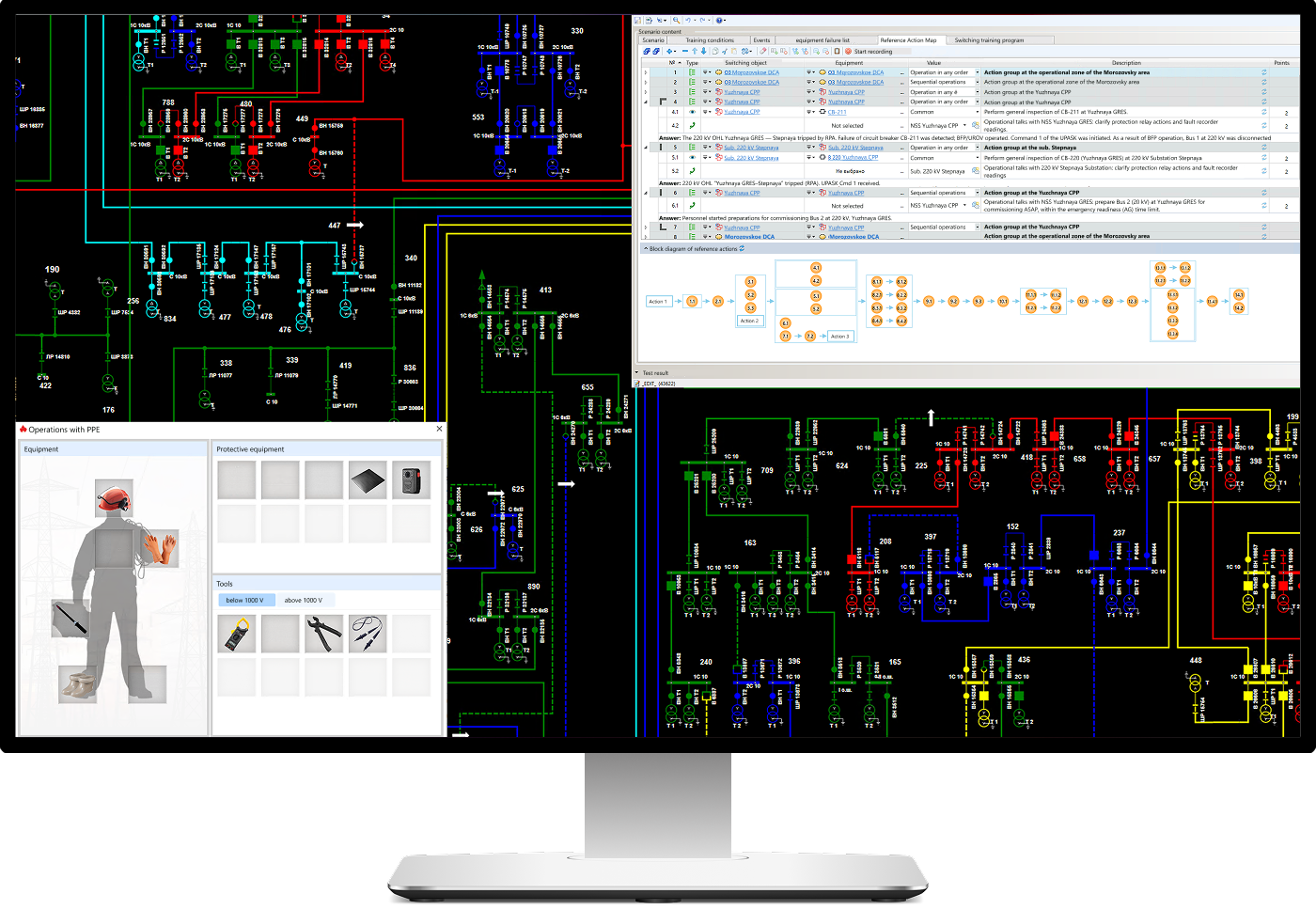
High-Performance SCADA
An enterprise-grade engine for high-performance processing, monitoring, and storage of real-time data streams—whether automated, manually entered, or generated by third-party applications. It serves as the mission-critical hub for Network Control Center dispatchers
- Engineered for big data and high-velocity streams from diverse sources. The system ensures long-term data retention with smart reduction algorithms, while mission-critical data is preserved in an immutable format.
- The advanced Topology Processor provides intuitive visualization of conducting equipment with dynamic coloring for deep network analysis. Intelligent manual input streamlines operations by automating routine tasks and implementing rigorous dispatcher action control.
- Analysis data is sourced from a diverse ecosystem, including telemetry, Automated meter reading and control system, and meteorological feeds. To ensure absolute data integrity, the system can restore invalid telemetry via redundant sources, reporting/planned parameters, forecasts, or manual input. Every incoming value undergoes a comprehensive validity verification process.
- The platform tracks advanced statistical telemetry behavior—including extrema, limit violations, and parameter surges. This intelligence is critical for precision equipment tuning and proactive outage rate reduction.
- An intelligent notification engine keeps users informed of critical system events. Events are organized into smart summaries, tailored by event type and associated objects.
- CK-11 empowers users with a sophisticated analytical suite for complex calculations. The base calculation subsystem features an intuitive logic editor, supporting universal aggregation (integrals, weighted/arithmetic means, extrema, sums) across customizable timeframes from 1 minute to 1 year.
- The Analytical Calculation subsystem provides advanced operational intelligence for complex scenarios involving extensive information model data. It enables retrospective analysis for predictive modeling and the automation of complex technological process chains.
- A core differentiator of CK-11 is its high-fidelity visualization of the network topology and operating state, featuring advanced display control tools. Dynamic scaling enables a layered presentation of data, with the level of detail automatically adapting to the current zoom level. Simultaneously, the Topology Processor manages dynamic coloring, allowing for comprehensive network analysis in various modes:
- by energization status;
- by operational responsibility;
- by supply centers;
- by voltage class (independent of current network topology);
- by asset ownership.
- The Topology Tracing service enables deep-dive network analysis by highlighting critical electrical paths:
- path from a selected element to the supply center;
- path between two selected network elements;
- all elements powered by the same supply center as the selected one;
- branch powered via selected switch or line.
- CK-11 integrates comprehensive management of temporary equipment. Dispatchers can digitally map temporary grounds, jumpers, cuts, unbolting, and mobile generators, alongside dispatcher and safety tags. This temporary equipment is dynamically factored into both topological coloring and real-time SCADA/ADMS operations. The system maintains an inventory log of installed temporary equipment; for temporary grounds and mobile generators, it tracks deployment from warehouse stocks, recording equipment numbers and verification dates. Dispatcher tags ensure personnel safety during equipment operation.
- The SCADA environment features full geospatial integration. The toolkit ranges from visualizing technological and infrastructure data on any map to loading fire reports and integrating cadastral maps, and from visualizing trouble tickets and outages to real-time tracking of field crews.
Operational Parameter Monitoring
The system dynamically calculates current operational limits for current and voltage, identifying equipment equipment limit violations considering real-time weather conditions to enable rapid response. It also monitors permissible durations for equipment in steady-state modes
- Upon detection of a violation on monitored equipment, the system triggers immediate visual alerts on the diagram, provides detailed diagnostics via specialized control forms, modifies telemetry quality flags, and aggregates violation statistics for automated reporting.
- Monitoring operates as a continuous background process; the dispatcher's attention is engaged only when immediate action is required within their specific area of responsibility (AoR).
- Dedicated subsystems provide precision monitoring. The Voltage Level Monitoring subsystem tracks operational limit violations and optimal voltage schedules to guarantee power supply quality.
- The Current Load Monitoring subsystem detects equipment overloads by correlating current with ambient temperature and duration, while also monitoring phase current asymmetry.
Advanced Switching Management
Automates switching operations in high-voltage and distribution networks via intelligent switching programs/orders, dynamically generated based on the current topology and objective (e.g., maintenance outage or normal topology restoration, etc.)
- Depending on network observability, scheduled and emergency outages can be fully automated (with dispatcher oversight) or managed via direct commands to field crews and on-duty personnel, featuring automatic diagram activation to reflect the actual state, even in non-telemechanized sectors.
- All switching steps are captured in the Electronic Logbook with multi-level verification for every operation to ensure zero-error execution.
- The system provides real-time visibility into capacity reserves connected to the remedial action scheme and load shedding volumes based on emergency schedules and telemetry. It supports group telecontrol for efficient load shedding and features advanced safety interlocks (e.g., administrative interlock, energized ground protection, and short-circuit prevention).
- The integrated FLISR assistant suggests optimal switching sequences for maintenance or emergency recovery based on real-time network topology and operational limits, eliminating planning errors and accelerating decision-making.
- Even greater efficiency is achieved through AutoFLISR, a service for the automated restoration of customer power supply. It automatically identifies the faulted section, isolates the damaged equipment or power line, and restores power to customers using the optimal calculated path—requiring zero human intervention.
Network Analytics and Intelligence
A comprehensive suite of network analysis tools, including unbalanced load flow analysis in current topology, allowing for "what-if" scenario testing, short-term operational planning, and strategic network development
- Operational analytics run in real-time, providing dispatchers with advisory alerts and signal indicators on graphical diagrams. A dedicated "Study Mode" allows dispatchers to simulate and evaluate the impact of potential switching operations.
- For non-operational strategic tasks, the system offers advanced interactive analysis, including any-mode simulation, load forecasting, and equipment failure contingency analysis. To address complex challenges beyond real-time operational control of electrical networks, the platform offers advanced interactive analysis. This empowers users to simulate any state of operating conditions, perform load forecasting, and conduct equipment failure contingency analysis, among other sophisticated calculations.
- The system intelligently streamlines the model to the optimal size for specific tasks, creating agile analytical models. Transformation algorithms are managed centrally and kept active.
- State estimation leverages advanced data on conducting equipment and proprietary observability restoration algorithms.
The system provides:
- gross error correction for switch state signaling and telemetry;
- transformer tap changer position estimation;
- capacity estimation for сontrolled shunt reactors, static var compensators, and STATCOM;
- explicit switch and measurement accounting.
- Real-time state estimation allows dispatchers to visualize calculated parameters on non-telemechanized network sections and replace invalid measurements with high-accuracy estimated values.
- An extensive toolkit is provided for the calculation and analysis of normal, emergency, and post-emergency power flows. It is possible to create a group of independent information models for specific areas, network topologies, or analysis tasks based on the full information model of the physical equipment.
- CK-11 enables precision energy balancing and technical/commercial loss analysis in distribution networks. By integrating meter data and topology changes, it localizes high-loss areas and detects unauthorized power draws or metering anomalies.
- Unbalanced load flow analysis allows for the calculation of single-, double-, and three-phase short-circuit currents to verify switch breaking capacity and thermal/electrodynamic withstand of equipment, locate power line faults, and optimize relay protection setpoints.
- Data on switch breaking capacity and values characterizing the electrodynamic and thermal withstand of equipment are used to monitor the breaking capacity and equipment withstand against calculated short-circuit currents. This control can be carried out in real-time as the electrical network's operating state changes.
Simulation-Based Training for Personnel
CK-11 features a fully isolated simulation environment, completely separated from the primary control mode, that emulates the dispatching ecosystem with high-fidelity reproduction of all critical real-world power system processes
- Trainees use the exact toolset as in live operations, progressing from basic induction to mastery of typical, pre-emergency, and emergency network modes.
- Scenarios include dynamic network reconfiguration, load/generation shifts, and simulations of PPE use, operational communications, and temporary outage schedules. A specialized simulator is dedicated to mastering operational switching.
- The portfolio features three specialized simulators for operational and dispatching excellence.
Filin Simulator
A high-fidelity DTS simulator for power system control centers, designed to cultivate advanced management skills through dispatcher, system-wide, and inter-system emergency trainings and professional competitions. It can be used for dispatch, system-wide, and inter-system emergency response drills, professional skills competitions, and training in operating СK-11 components.
Filin is powered by a dynamic calculation model that reproduces power system behavior, calculating both power flow sequences between switching operations, disturbances and complex transient responses.
Key Capabilities:- Detailed modeling of:
- — transformers, taking into account the possibility of both longitudinal and transverse transformation ratio regulation;
- — emergency signaling;
- — remedial action scheme (RAS) devices (ULS, UIS, UVP, OCPD, PSP, etc.);
- — operational automation (ALFC, GAPC, Group Regulator of Reactive Power and Voltage, etc.);
- — frequency/voltage-dependent customer loads;
- — voltage regulators (SCB, CSR, SVC, STATCOM).
- Initial state generation (including SCADA archive integration)
- Scenario-based training with dynamic inputs:
- — emergency outages of switches, busbars, lines, and generating units;
- — operational and emergency automation failures;
- — communication channel/telemechanics breakdowns.
- Telecontrol simulation
- Participation of multiple control centres in a collaborative training
- Felix Simulator
A DTS simulator dedicated to network operational personnel, providing hands-on expertise in the operational and technological management of electrical grids. It enables personnel to gain skills in operational and technological management of electric power networks.
The Felix Simulator enables dispatch, substation/zone, district, and system-wide emergency response drills, as well as professional skills competitions for operations personnel. Precise network behavior is achieved through iterative power flow calculations and detailed modeling.
Key Capabilities:- Extensive parameter modeling:
- — primary equipment;
- — emergency signaling;
- — voltage-dependent customer loads;
- — voltage regulators (SCB, CSR, SVC, STATCOM);
- — network automation devices (ALT , UFLS , etc.);
- — temporary equipment (mobile generators, temporary grounds , jumpers/cuts on lines).
- Initial state generation (including SCADA archive integration)
- Scenario-based training with dynamic inputs:
- — emergency outages of switches, busbars, lines, and transformers;
- — grid automation failures;
- — communication channel/telemechanics breakdowns;
- — customer power loss reports.
- Simulation of telecontrol of switches and remote entry of temporary outage schedules
- Participation of multiple control centers in a single training session
- NOTS Simulator
The NOTS Simulator is designed to train personnel of electric grid operational dispatch control centers in the sequence of performing switching operations, as well as to conduct professional skills competitions.
Unlike DTS simulators, NOTS focuses exclusively on strict algorithmic adherence. Using a predefined reference action map, it provides formalized evaluation of every step. It can operate autonomously or as a verification module integrated with Filin/Felix.
Key Capabilities:- Specification of equipment faults in the training scenario
- Definition of additional events (emergency equipment outages, supplementary inputs, etc.) and their automatic triggering during training
- Training in both educational (with hints) and control mode
- Simulation of operational communications
- Simulation of working with personal protective equipment (PPE)
- Multi-user sessions
- Integrated switching and DTS training (with Filin/Felix)
- Reference action map generation (including automatic import from CK-11 switching programs)
- Automated performance evaluation and action logging
Key Features
Common Information Model

End-to-End Automation

Online Network Analysis

Dispatcher Assistant

RELIABILITY
EFFICIENCY
SCALABILITY
A comprehensive digital platform for the strategic management of electrical grid assets for utilities and industrial enterprises of any scale
СК-11 Implementation Benefits
Economic
01Reduced Energy Supply Interruptions
Automated fault location and generation of optimal switching options, together with automated restoration of customer power supply, reduce the time required to resolve outage situations
02Reduced Energy Losses
Calculation and analytical applications help identify points of unauthorized power consumption (commercial losses) and optimize operating conditions to reduce technical energy losses
03Reduced Staffing Requirements
Process automation based on a unified platform, together with the built-in Dispatcher Assistant, can significantly reduce the required number of dispatchers. Performing all network calculations using a single model also eliminates duplicate entry of calculation data, further reducing staffing requirements
Operational
01Enhanced Operational and Technological Management
Automated switching control tools based on a physical equipment model improve the speed and quality of operational decision-making while reducing the impact of human error
02Improved Power Supply Reliability and Quality
Predictive analysis of equipment operating conditions and the use of advanced integrated monitoring and automated control solutions help reduce the number of unplanned outages
03Reduced Workplace Injuries
Multi-level checks and interlocks during switching operations provide additional protection against accidents, while comprehensive automation of the order management system contributes to a stronger safety culture
Reputation and Social
01Improved Decision-Maker Awareness
The system provides timely information to enterprise management about emergency situations and supports decision-making during emergency response
02Greater Transparency and Objectivity of Reporting
Electronic document management within the APCS and automatic event recording ensure the accuracy and completeness of collected information and support timely report submission
03Enhanced Public Image of Power Distribution Companies
Customers receive information about planned and emergency works automatically or through the contact center, which automatically receives the information required to respond to customer inquiries